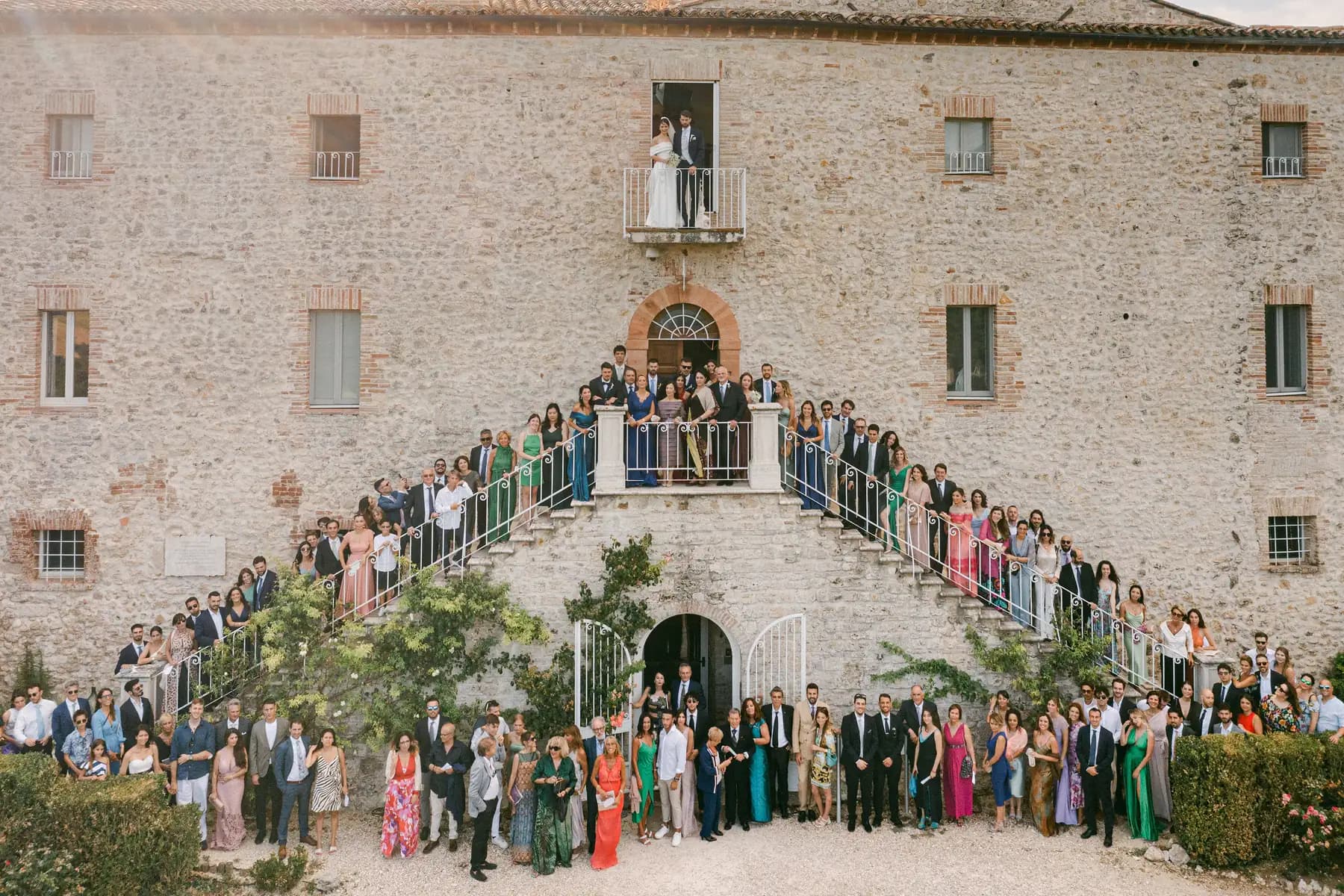
Caterina and Gianluca were married at Castello di Montignano, in Massa Martana, in the province of Perugia. The ceremony took place in the church inside the hamlet, the portraits in a sunflower field a few steps from the walls, and the party ran late into the night — with a dress change for the cake cutting and a flower bar that kept the guests on their feet longer than the cake did.
Castello di Montignano is one of the venues I most enjoy going back to, and this was not my first time working here: I also photographed Martina and Daniele's wedding at this castle. Knowing a place changes the way I photograph it. I know where the light falls at seven in the evening, I know which corner of the garden holds a portrait even at midday, and I know the medieval walls need a precise few minutes — not an hour — to give their best. That means spending the day watching people instead of hunting for compositions.
The ceremony in the castle church
Caterina and Gianluca chose the church inside the hamlet. It is a choice that makes the whole day simpler: no transfers between ceremony and reception, no dead time for the guests, no racing the clock. You step out of the church and you are already where the party is.
Photographically it is a small church, with little light and high windows. I work with very fast lenses and no flash during the rite: I would rather raise the ISO and keep the real atmosphere of the room than flatten everything with artificial light. The frames that survive from those minutes are the ones where nobody notices a photographer was there.
Portraits in the garden and the sunflower field
After the ceremony we took half an hour — no more — for the couple's session. First in the castle garden, in the shade of the olive trees, then in a sunflower field close by.
The sunflowers were at their best: that one week in July when they still all face the same way and their heads are not yet heavy. It is a setting that lasts only briefly in Umbria and has to be caught: two weeks earlier they are green, two weeks later they are dry. If you dream of sunflower portraits, your wedding date matters more than your photographer.
That half hour away from the guests is almost always when a couple truly relaxes. I talk very little, I walk with them, and I let them forget I am there.
The dress change and the cake cutting
For the cake cutting, Caterina came back in a second dress. It is something I often suggest when the party is a long one: changing halfway through gives the day a second act, it takes the weight off after hours of train, and — very practically — it delivers a second set of portraits completely different from the first, with evening light instead of afternoon light.
The flower bar by Mariana Flowers
The best idea of this wedding was the flower bar created by Mariana Flowers: a counter of fresh flowers for the guests, who could put together a bouquet to take home.
It worked better than any entertainment. It broke the ice between tables that did not know each other, it kept the children busy, and it created a constant coming and going which, for a photographer, is gold: people move, laugh and mix, and the photographs stop being group portraits and start being scenes.
The party
The reception carried on in the castle's outdoor spaces, with the lit walls as a backdrop. The film of the day was made by Maurizio Rinaldi Wedding Films, whom I had already worked with here: when the photographer and the videographer know each other, the couple notices — neither gets in the other's way, and nobody asks to repeat a moment that has already passed.
Getting married at Castello di Montignano: what to know
If you are considering this venue for your own wedding, here is what I have learned working here.
Where it is
The castle is in Massa Martana, in the province of Perugia, on the hills of the Monti Martani. It is a central position in Umbria: it is reached by car from Rome and Florence, and Perugia is the closest airport — a real advantage if you have guests travelling from outside the region or from abroad.
The spaces
It is a fortified hamlet restored as a relais and spa. There is the church, the gardens, an olive grove, a panoramic pool and a wellness centre. The practical consequence is that ceremony, aperitivo, dinner and party all sit inside the same perimeter: your guests never get back in a car, and you do not lose two hours of the day to transfers.
Civil, religious or symbolic ceremony
Castello di Montignano is licensed for civil ceremonies, including outdoors. For a religious rite there is the church inside the hamlet, the one where Caterina and Gianluca were married. A symbolic ceremony is always possible, with the legal papers signed at the town hall — the route many international couples take. Foreign couples also need the nulla osta from their consulate; I cover the whole process in my guide to planning a wedding in Italy from abroad.
How many guests
The spaces work well from around 40 up to 175 guests. It is a wide range, which makes the venue suitable both for a large celebration and for something more intimate without the spaces feeling empty.
Staying at the castle
There are suites inside the hamlet. Having the couple and some of the guests sleeping on site changes the rhythm of the day: getting ready becomes slower and far nicer to photograph, and in the evening nobody is watching the clock to get back to a hotel.
How I photograph a day here, hour by hour
- Morning, getting ready. If you stay at the castle, preparations happen in the suites: window light, soft, perfect for the details of the dress and for make-up. Caterina's make-up was by Laura Ricci Make Up. I always ask for the curtains open and the artificial lights off.
- Ceremony. There is little light in the church and no flash is used. Discretion matters more than technique here.
- Aperitivo, early afternoon. The worst hour for light: high sun and hard contrast. We work in the shade of the olive trees and in the garden, where the shade is clean and the greenery acts as a natural reflector.
- Golden hour. This is when the place gives its most: the stone of the walls catches fire and the hills behind flatten into layers. Fifteen minutes are enough, but they have to be planned in advance — left to chance, they arrive while the main course is being served.
- Evening. The lit walls become the backdrop of the party. Here I work with mixed light and slow shutter speeds to keep the real atmosphere, without turning the dance floor into a set.
If you would like help fitting all of this into your schedule, I have written a guide on what to expect on your wedding day, with a timeline.
The team behind this wedding
- Venue — Castello di Montignano, Massa Martana (PG)
- Film — Maurizio Rinaldi Wedding Films
- Flower design and flower bar — Mariana Flowers
- Make-up — Laura Ricci Make Up
- Photography — Manuel Diamanti
Gallery
Frequently asked questions
Can you get married at Castello di Montignano?
Yes. Castello di Montignano is a historic hamlet in Massa Martana (Perugia) that hosts weddings and is licensed for civil ceremonies, including outdoors. There is also a church inside the hamlet for a religious rite, and a symbolic ceremony can be arranged.
Where is Castello di Montignano?
In Massa Martana, in the province of Perugia, on the hills of the Monti Martani, in the heart of Umbria. It is reached by car from Rome and Florence, and the nearest airport is Perugia.
Can you marry in the castle's church?
Yes. Caterina and Gianluca were married in the church inside the hamlet, keeping ceremony and reception in the same place, with no transfers between one moment and the next.
How many guests does Castello di Montignano hold?
The spaces work well from around 40 to 175 guests, which makes it suitable both for large weddings and for more intimate celebrations.
How much does it cost to get married at Castello di Montignano?
Costs depend on the season, the number of guests and the services chosen, and they are set by the venue itself: it is best to ask them directly for an up-to-date quote. On the photography side, I have written an honest guide to wedding photographer pricing.
When is the best time to get married at Castello di Montignano?
From May to September the outdoor spaces are at their best. If you want sunflower portraits like Caterina and Gianluca's, the window is narrow: usually between late June and July, and it shifts from year to year.
Can you stay at the castle?
Yes, the hamlet is a relais with suites. Having the couple and some of the guests stay on site makes the day more relaxed and the preparations far nicer to photograph.
Why choose a photographer who already knows the venue?
Because they do not have to discover the place on the day. Knowing in advance where the light falls, which corners work and how long each move takes means asking you to pose less and letting you live your day more. I write about this in my guide to choosing a wedding photographer in Umbria.
Castello di Montignano is among the venues I most often recommend to the couples who write to me, and you will find it in my guide to wedding venues in Umbria alongside thirty more.
If you are thinking of marrying here, have a look at my portfolio and the other wedding stories, or tell me about your wedding: I answer every message personally.