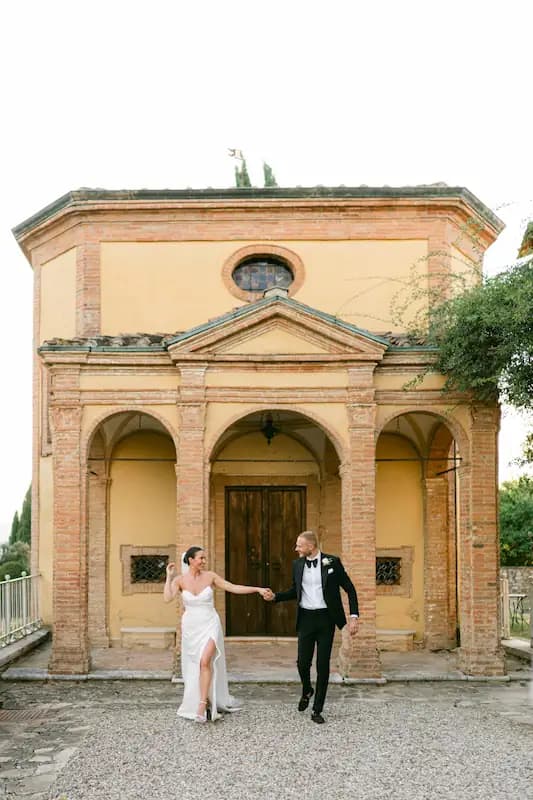
Florence is a Renaissance masterpiece in the open air — its historic centre is a UNESCO World Heritage Site — and the choice of venue directly affects the quality of the photographs. Architecture that is already art, the light of the Arno valley, the chance to go from an intimate staircase to grand impact in a five-minute walk: here are the Florentine venues I love most, sorted by type, with the practical advice you rarely see written down.
Why Florence is perfect for photography
The morning light reflects off the Arno and the pietra serena with a golden warmth; the evening draws long shadows between the alleys and sets the façades alight. Even intimate spaces deliver strong visual impact thanks to the architecture: in Florence there's no such thing as a dull backdrop. The flip side is the crowds at the landmark spots and the rules of the historic city: which is why the choice of venue and timing counts double.
Historic palazzi
- Palazzo Corsini al Prato — a monumental staircase, frescoed halls and a Baroque courtyard-garden; ideal for 50–120 guests, beautiful in the morning light through the windows.
- Villa San Martino — on the hills around the city, a Renaissance loggia and Italian gardens with a view of the skyline and the Brunelleschi dome in the distance.
- Palazzo Borghese — a gem in the heart of the centre, period halls and a courtyard with a Renaissance well; perfect for elegant indoor receptions.
- Palazzo Gondi and Palazzo Vecchio (Sala Rossa) for the civil ceremony right in the centre, with a historical weight few cities in the world can offer.
Villas and gardens
- Villa Cora — neoclassical luxury in the Oltrarno, panoramic terraces and frescoed halls; one of the most sumptuous settings in the city.
- Villa Gamberaia (Settignano) — among the most scenic Italian gardens in Europe, with geometric parterres, pools and cypress avenues. A dream for portraits.
- Giardino Corsini and Giardino Torrigiani — historic gardens in the heart of Florence, ancient trees and intimate corners away from the traffic.
Churches and sacred places
- Basilica di Santo Spirito — a Brunelleschi design, perfect Renaissance proportions and light coming from above.
- San Miniato al Monte — on the city's highest hill, a white-and-green marble façade and a view worth the wedding on its own.
- Basilica della Santissima Annunziata — on the side of the porticoed square of the same name, among the most beloved by Florentines.
Rooftops and terraces
- The rooftop of Hotel Davanzati and similar — a 360° view over the centre, with the Duomo's dome the star at sunset.
- The loggia of Palazzo Guadagni — a covered space with Renaissance arches overlooking Santo Spirito.
- The terrace of Villa Bardini — terraced gardens on several levels and one of the finest views over all of Florence, less crowded than the nearby Piazzale Michelangelo.
Where to shoot the portraits in Florence
Even if you marry at a villa, it's worth carving out half an hour for portraits in the city. My favourite spots: Piazzale Michelangelo at dawn (deserted, with all of Florence at your feet), the Ponte Vecchio in the first morning light before the tourists, the Giardino delle Rose and the Giardino Bardini below the Piazzale, the alleys of the Oltrarno around Santo Spirito, and the lungarni at sunset. A tip from someone who's learned it the hard way: the first photos of the day, with the city empty, are worth any dawn wake-up call.
The logistics nobody mentions: ZTL and permits
The centre of Florence is almost entirely a ZTL (limited traffic zone): the cars of the couple and guests need permits, and improvising means fines. Coordinate it with the venue or planner in good time. Some churches and historic sites require photography permits or have rules on flash and tripods: check beforehand, not on the day. And if you dream of a portrait on the Ponte Vecchio, plan on a dawn wake-up: it's the only time it's yours.
Seasons and light
- Spring — gardens in bloom, mild courtyards, clean light. The ideal season.
- Summer — serious heat in the city: better to use shaded loggias, villas on the hills and evening ceremonies at golden hour.
- Autumn — dramatic light, warm colours and fewer crowds. Very underrated.
- Winter — intimate interiors, striking skies and the city almost to yourselves; you work a lot with architecture and enclosed spaces.
Once you've chosen the venue, it's worth thinking about timing: I've described a typical day in what to expect on the wedding day in Tuscany. More ideas on itineraries and surroundings on the official portal Visit Tuscany.
Frequently asked questions
Do you need a permit to photograph in the historic places of Florence?
Some venues, churches and gardens require permits or have specific rules on flash, tripods and timing: check in advance, usually through the venue or the wedding planner. For public spaces like the lungarni nothing is needed, other than getting up early.
How do you handle cars in the centre with the ZTL?
Most of the historic centre is a limited-traffic zone: vehicles for the couple and guests need permits, which the venue or planner requests in advance. For transfers, an authorised car with driver is the easiest option.
Which venue is best for photography?
It depends on the style: palazzi for formal elegance, villas and gardens on the hills for natural light and privacy, rooftops for the panoramas with the Duomo. Often the best solution is to combine two in the same day.
How many guests for a wedding in Florence?
From intimate ceremonies in chapels and municipal halls to receptions of over a hundred guests in the palazzi and villas: there's a setting for every number.
Related articles
- The wedding day in Tuscany, with a timeline
- Luxury wedding photographer in Italy
- Wedding photographer in Italy: the guide
Dreaming of Florence as your setting? Get in touch: let's choose the right venue for your story — and for your photographs.